Make people want to join in.
I build quizzes, rebus walks, live maps and small games for municipalities, museums, festivals and brands. Things people play, not just look at.
- Formats
- Quizzes, rebus walks, live maps, small games
- Runs in
- The browser via a QR code, or its own app
- For
- Municipalities, museums, festivals, brands
- Background
- Game development, Unity and Unreal Engine
01 · Three formats
What should people do?
- Web app
For one event
A quiz, a live map and a prize draw, straight in the browser.
- Nothing to download, just a QR code
- Sends people where you want them
Festivals, trade fairs and campaigns.
- App and website
A rebus walk
A walk with stops, questions and photo tasks on a map.
- You build the walk yourselves in the browser
- Works offline when the signal disappears
School trips, team days, museums and city walks.
- Its own app
A walk with points
The city's own streets become a walk with points for every place people find.
- You manage the content yourselves from an admin site
- Made to be used year after year
Municipalities and destinations.
02 · Fig. 1 · Norsk Gjenvinning at Bergenfest
Thousands of players in one weekend.
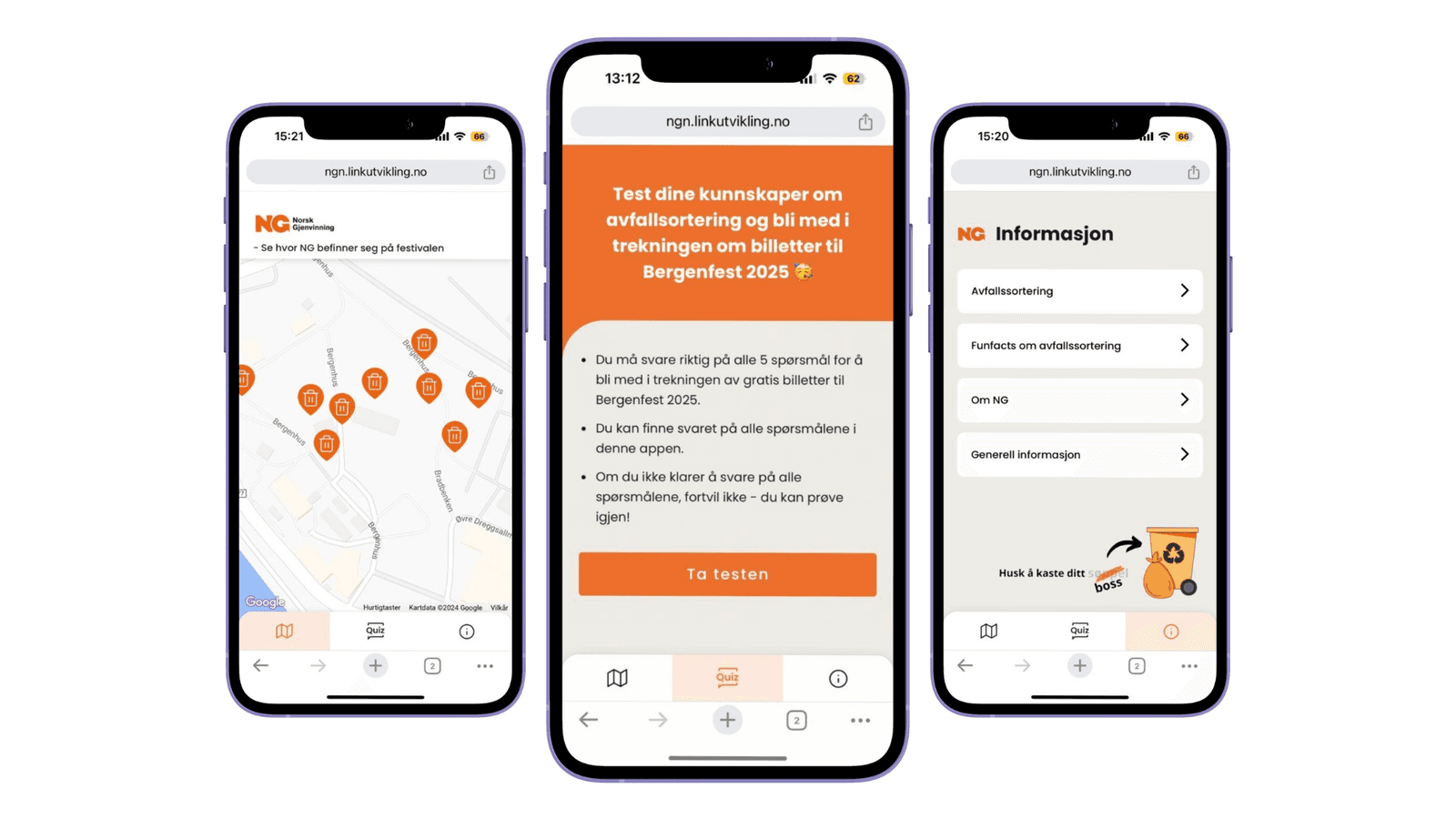
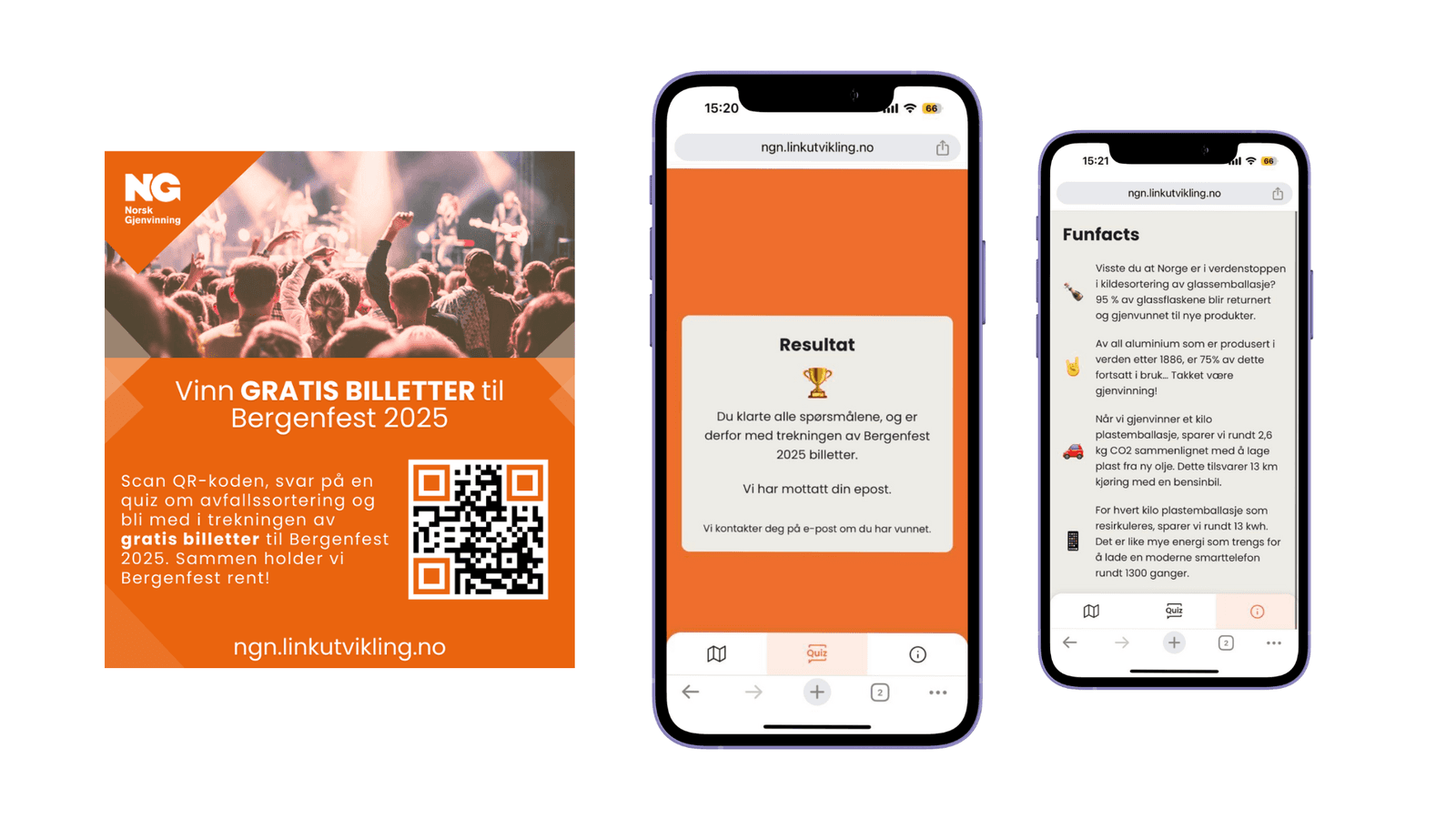
Norsk Gjenvinning wanted festival guests to find their recycling stations and their lounge, and to have fun doing it. I built a web app with a quiz about sorting waste, a prize draw at the end and a live map of the stations and the lounge. Nothing to download, just a QR code and a phone.
We also made the concept and the visual identity for the lounge. It was used by thousands over the weekend, and was made to work on a cracked phone screen in the rain.
03 · Fig. 2 · Rebu
Any walk can be a rebus.
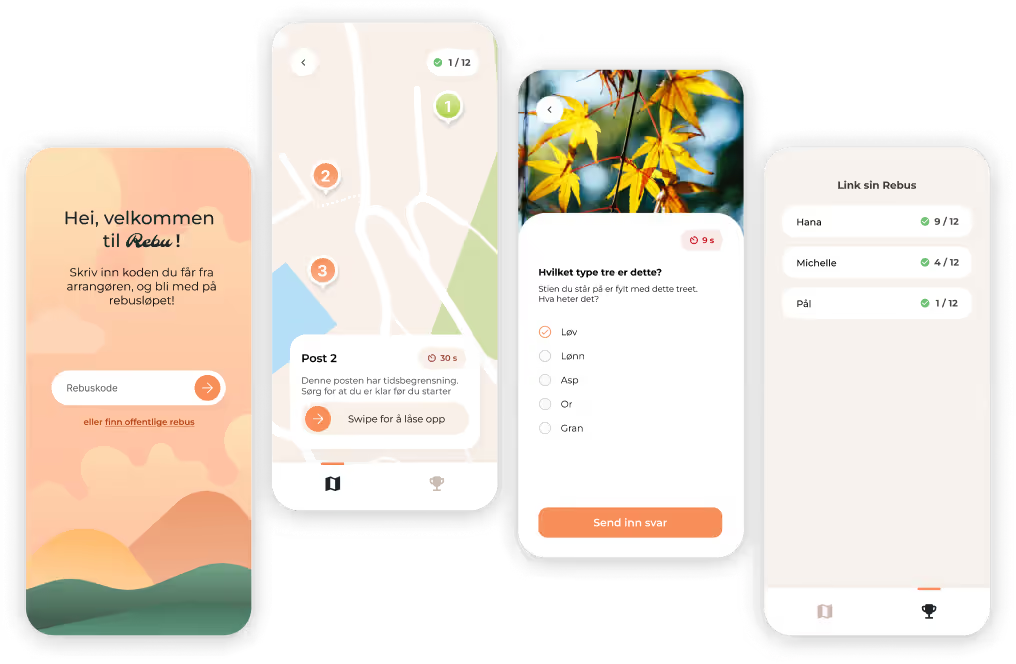
You build the rebus in the browser, on a big screen with a keyboard. The participants follow it in the app, on a map made for walking, and it works offline when the signal disappears in the woods.
A school trip, a team day or a birthday in the park is set up the same way.
04 · For you
What it could look like.
A municipality
can turn its own streets into a walk with points for every place people find, so residents discover the city they live in.
A museum
can hide a rebus in the exhibition, so those who usually walk straight past the signs stop and read to find the answer.
A festival or an event
can use a quiz, a live map and a prize draw to send people where you want them.
A brand
can get people to spend a few minutes with it because they want to, through a small game or a 3D world that runs in the browser with nothing to download.
05 · In depth · Why it works
Fast answers, small rewards and a reason to continue.
In a good game you tap, see at once whether you were right, get a few points and want the next question. That is the whole trick.
The same three things get someone to walk one more stop on a heritage walk, read the sign they would otherwise pass, or find the deposit station in the middle of a festival. A poster asks people to pay attention. A game gives them something to do.
06 · Background
Games taught me most of what I know about making things feel good to use.
I studied computer science and game development in San Diego, have made games in Unity and Unreal Engine 5, worked in UEFN, and build 3D for the web in Three.js. I also have more than ten years of apps and systems for companies, so the playful part comes with something solid underneath.
The front page of this website is a small game too: an office in 3D where you click on things and I fetch them, and there is Tetris on the TV.
Common questions.
Do people have to download an app to play?
No, not necessarily. A quiz or a map can run straight in the browser via a QR code. For longer walks and rebus walks that must work offline, an app is better.
Can we make the game ourselves afterwards?
Yes. I often build a tool where you add questions, stops and prizes yourselves, so you can make new rounds without me.
What do you want people to feel like doing?
Tell me who it is for and where it will happen. I reply within a day.